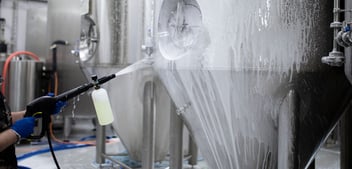
Year-end shutdowns give industrial facilities a chance to tackle maintenance, cleaning, repairs, and equipment changes that are difficult to complete during normal production. They can also create wastewater streams that look very different from what a facility manages the rest of the year.
For many manufacturers and industrial facilities, late Q4 is maintenance season.
Production may slow around the holidays, lines may be taken offline, and teams finally get access to tanks, piping, heat exchangers, cooling systems, production equipment, and other areas that are difficult to service while the plant is running.
That makes shutdowns valuable. It also makes them unusual.
The wastewater generated during a shutdown may come from cleaning, draining, flushing, descaling, hydrotesting, equipment replacement, tank cleanouts, cooling-system maintenance, or years of accumulated material that normally stays inside the process.
EPA regulations even recognize maintenance wastewater as a distinct category in some industrial settings, including wastewater created when equipment is emptied or purged during temporary shutdowns, inspections, repairs, and routine maintenance.
The important part for most facilities is simpler: wastewater generated during a shutdown may not behave anything like normal production wastewater.
When the Line Stops, the Cleaning Starts
A production line running normally tends to create relatively predictable waste streams. Operators know where the water comes from, what products are being made, and roughly what chemistry to expect.
A shutdown can change that quickly.
Maintenance crews may drain systems that have not been emptied in months. Tanks may be pressure washed or chemically cleaned. Heat exchangers may be descaled. Cooling loops may be flushed. Product lines may be cleared before equipment is replaced. Oil-water separators, pits, sumps, and containment areas may finally be cleaned out.
A current industry guide on year-end shutdowns describes the period as a rare opportunity to open, de-energize, and deep-clean facility systems that normally have to remain available for production.
Each individual project may make perfect sense. Taken together, though, they can produce a short burst of wastewater with higher solids, stronger chemistry, more oil, unusual pH, accumulated sludge, cleaning agents, or other contaminants that are not normally present at the same concentrations.
The Volume Can Arrive All at Once
Shutdown wastewater can also create a scheduling problem.
During normal operations, wastewater may be generated steadily enough for onsite treatment, storage, hauling, or sewer discharge systems to keep pace. A shutdown can compress days or weeks of cleaning and maintenance into a very short period.
Several tanks may be drained at once. Multiple contractors may be flushing equipment. A cooling system may need to be emptied before freezing weather. A production area may be washed down immediately before crews leave for the holiday.
The result can be a large amount of water appearing in a very small window.
That matters because treatment capacity, tank capacity, trucking availability, and receiving-facility schedules do not automatically increase just because the plant has chosen the same week for its maintenance work.
The Wastewater May Be Stronger Than Normal
One of the easiest mistakes is assuming shutdown wastewater is simply more of the same water the facility normally generates.
Often, it is not.
A tank cleanout can mobilize solids that have settled for months. A line flush can pick up concentrated product residues. Descaling may introduce acidic or alkaline cleaning solutions. Equipment maintenance can produce oily water or metal-bearing wastewater. Cooling-loop work may involve glycol, corrosion inhibitors, biocides, or accumulated metals.
Even relatively clean rinse water can become difficult to manage if it is mixed with one much stronger stream.
That is why it helps to identify the likely source of each wastewater stream before maintenance begins rather than trying to characterize everything after it has already been combined.
Winterization Adds Another Layer
For facilities in colder climates, year-end maintenance often overlaps with winterization.
Cooling systems, outdoor piping, tanks, and other water-containing equipment may need to be drained, protected, or chemically treated before temperatures drop. ASHRAE guidance for systems being placed into extended dry shutdown specifically calls for draining water from cooling towers, piping, heat exchangers, filtration equipment, and low points in the system.
Industrial cooling-system guidance also commonly recommends fall inspections, cleaning, water testing, freeze protection, and system layup before winter conditions arrive.
For a facility in Ohio, Michigan, Indiana, Pennsylvania, or another cold-weather market, that can mean normal year-end maintenance and seasonal draining are happening at the same time.
That combination can create wastewater from places that may not be touched again until spring.
Shutdowns Can Reveal What Has Been Building Up
Maintenance can also expose problems that were largely invisible during normal production.
A tank that appears to hold mostly water may contain a heavy layer of sludge at the bottom. A separator may have accumulated far more oil or solids than expected. A cooling loop may contain corrosion products. A pit may include residues from several different processes.
Those discoveries are not necessarily signs that something went wrong. In many cases, the whole purpose of the shutdown is to finally inspect and clean equipment that cannot easily be opened while production is running.
But they can change the waste profile quickly.
A project that was expected to produce a few thousand gallons of relatively simple wash water may suddenly include concentrated sludge, oily material, high solids, or chemistry that needs a different disposal route.
The Best Time to Plan the Wastewater Is Before the Shutdown
Shutdown planning usually focuses first on labor, equipment, contractors, safety, spare parts, and getting the plant back online on time.
Wastewater should be part of that same planning conversation.
A few questions can prevent a lot of last-minute problems:
- What equipment will be drained, cleaned, flushed, or replaced?
- How much water could each activity generate?
- Will cleaners, acids, caustics, glycol, oil, or other chemicals be involved?
- Can stronger streams be kept separate from relatively clean water?
- Is there enough onsite storage if several projects generate water at once?
- Does the existing treatment or discharge system have enough capacity?
- Will outside transportation or treatment be needed?
- Are receiving facilities and haulers operating on normal schedules around the holidays?
The goal is not to make shutdown planning more complicated. It is to avoid discovering on December 27 that a tank is full, a contractor cannot continue work, and nobody has decided where the wastewater can go.
Keeping Streams Separate Can Save Money
Shutdowns are also one of the clearest examples of why wastewater segregation matters.
If 20,000 gallons of relatively straightforward rinse water are mixed with 2,000 gallons of concentrated oily or chemical wastewater, the entire 22,000 gallons may need to be managed based on the more difficult material.
Keeping those streams separate can preserve more treatment and disposal options.
It also makes sampling and characterization easier because everyone knows where the material came from.
During a busy shutdown, the temptation is often to send everything toward the same pit, sump, or tank because it is convenient. That can be the simplest operational choice in the moment and the most expensive wastewater decision afterward.
The Restart Can Generate Wastewater Too
The work is not necessarily finished when the maintenance crews leave.
Systems that were opened, cleaned, repaired, or modified often need to be flushed before returning to service. Cooling loops may need to be filled and circulated. Production equipment may require rinse cycles. New piping may need hydrotesting or commissioning.
That means some of the most important wastewater may be generated during startup rather than shutdown.
It is worth planning for both sides of the outage: what comes out when the equipment is taken offline, and what comes out when it is brought back online.
A Shutdown Is a Short Window With a Lot Happening
Year-end maintenance is often one of the busiest periods of the year even though the production floor may look unusually quiet.
Multiple projects are happening at once, contractors are working against tight schedules, and everyone is focused on getting the facility ready for the next production cycle.
Wastewater can easily become an afterthought until it starts slowing the work down.
Planning the expected streams, keeping unlike materials separate, confirming storage capacity, and lining up treatment and transportation before the shutdown begins can make the entire project easier.
At Valicor, we work with industrial facilities on wastewater generated during tank cleanouts, equipment maintenance, system flushing, cooling-loop work, shutdowns, commissioning, and other non-routine projects. The earlier those streams are identified, the easier it is to find the right treatment route and keep maintenance work moving.